

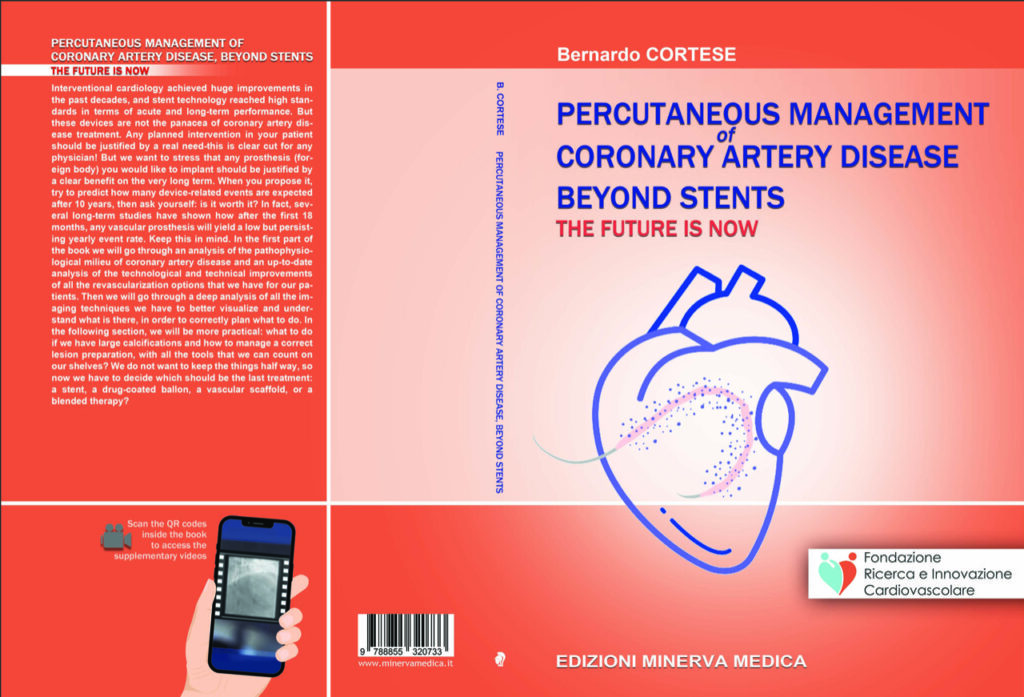
- Book title: Percutaneous Management Coronary Artery Disease Beyond stents. The future in now
- Editors: Bernardo Cortese
- Publisher: Minerva Medica
- Edition number: 1
A book about drug-coated balloons: are we challenging drug-eluting stents?
This book edited by Bernardo Cortese leads us into the DCB and in the metal free (bioresorbable scaffolds) world. The 23 chapters stem from the basic of percutaneous
coronary revascularization, imaging, appropriate lesions preparation for DCB implementation, different DCB platforms and specific antithrombotic therapies.
Interventional cardiology achieved huge improvements in the past decades, and stent technology reached high standards in terms of acute and long-term performance. But these devices are not the panacea of coronary artery disease treatment. Any planned intervention in your patient should be justified by a real need-this is clear cut for any physician! But we want to stress that any prosthesis (for-eign body) you would like to implant should be justified by a clear benefit on the very long term. When you propose it, try to predict how many device-related events are expected after 10 years, then ask yourself: is it worth it? In fact, several long-term studies have shown how after the first 18 months, any vascular prosthesis will yield a low but persisting yearly event rate. Keep this in mind. In the first part of the book we will go through an analysis of the pathophysio-logical milieu of coronary artery disease and an up-to-date analysis of the technological and technical improvements of all the revascularization options that we have for our pa-tients. Then we will go through a deep analysis of all the imaging techniques we have to better visualize and understand what is there, in order to correctly plan what to do. In the following section, we will be more practical: what to do if we have large calcifications and how to manage a correct resion preparation, wit all the roots mat we can count on our shelves? We do not want to keep the things half way, so now we have to decide which should be the last treatment: a stent, a drug-coated ballon, a vascular scaffold, or a biended therapy?
 Left Main Coronary Revascularization